17.8.17

MARBLE DREAMS


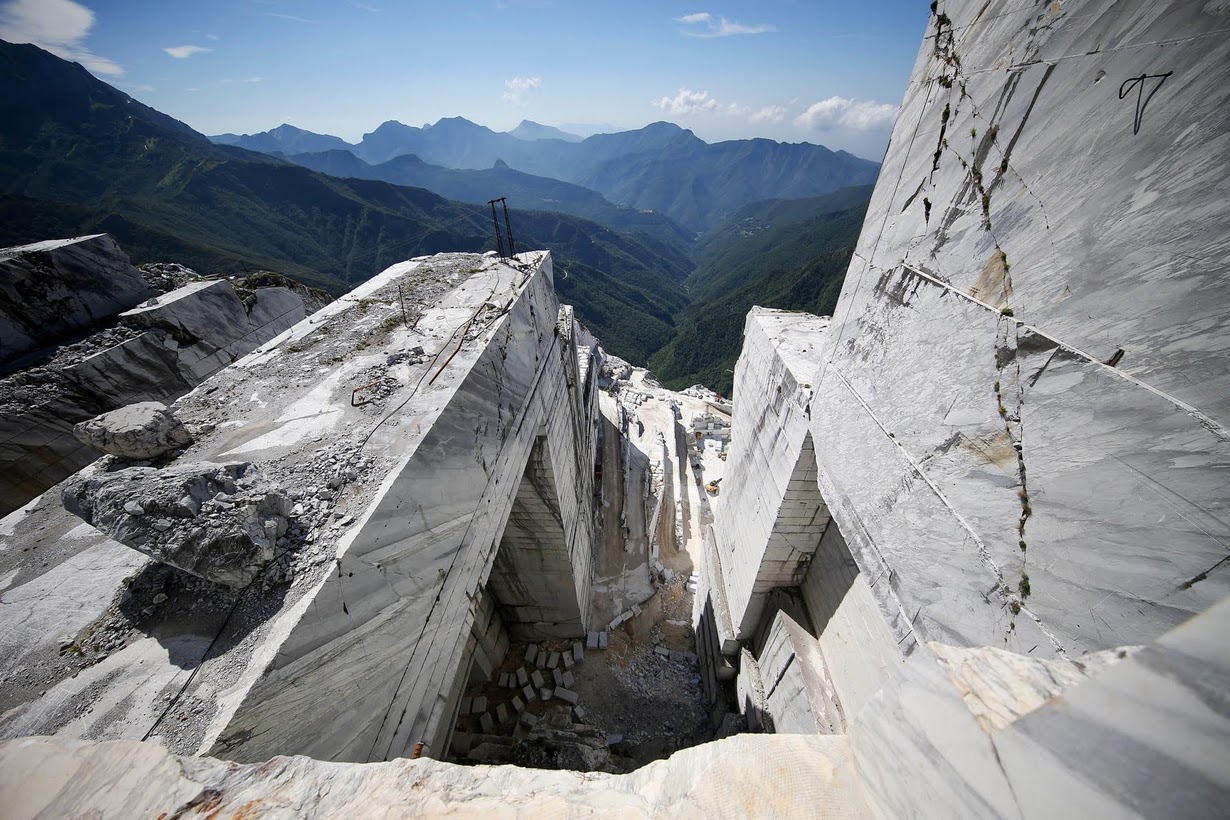
“QUERCETA DI SERAVEZZA, Italy (Reuters) - In 1517, Michelangelo climbed Mount Altissimo in Tuscany and found the marble of his dreams.It was, the Renaissance master wrote, “of compact grain, homogeneous, crystalline, reminiscent of sugar”. He deemed it perhaps even more precious than that from nearby Carrara, where he had obtained marble for some of his most famous statues. With the blessing of Pope Leo X, Michelangelo designed a path that could get blocks of the white marble down from the mountain to be transported to Florence to be used to decorate the facade of the church of San Lorenzo…  After several years of work to carve out a road… the project was abandoned. The church of San Lorenzo still has no facade… 
"Modern cutting and extraction techniques have produced a surreal landscape similar to some Cubism paintings, a dizzying array of upside down staircases and sugar-cube structures looking heavenward."
Before the extracting begins, experts known as “tecchiaroli” hang on ropes from the sides of the mountain and pick at its sides with pointy iron bars to remove loose rock that could fall and hurt workers in subsequent phases of the extraction."

18.2.17

THE BEAUTIFUL BRAIN


"Illustrations by Santiago Ramón y Cajal, the Spanish neuroscientist, from the book “The Beautiful Brain.” From left: A diagram suggesting how the eyes might transmit a unified picture of the world to the brain; a purkinje neuron from the human cerebellum; and a diagram showing the flow of information through the hippocampus in the brain"

More HERE

14.2.17

MARS ROVER


A photo from the Mars Rover with a tiny bit of the apparatus in shot.

4.1.17

DINOSAUR SUPERVISOR


Phil Tippet - the dinosaur supervisor in Jurassic park - opens up his studio:

"Tippett’s studio workspace is littered with props and miniature models of the cinematic icons that he helped to create. Over in the corner is an Imperial Walker, the quadrupedal troop transporter from The Empire Strikes Back. Hanging on the wall by the coffee machine is a life-size bust of the Reaper vampire from Blade II, with its hideous, gaping maw. Up in the rafters is the gigantic ED-209 kill droid from RoboCop."


Read the full article HERE

Watch the trailer for Mad God HERE

11.12.16

DO HO SUH'S FULL-SCALE APARTMENT RUBBING


do ho suh video

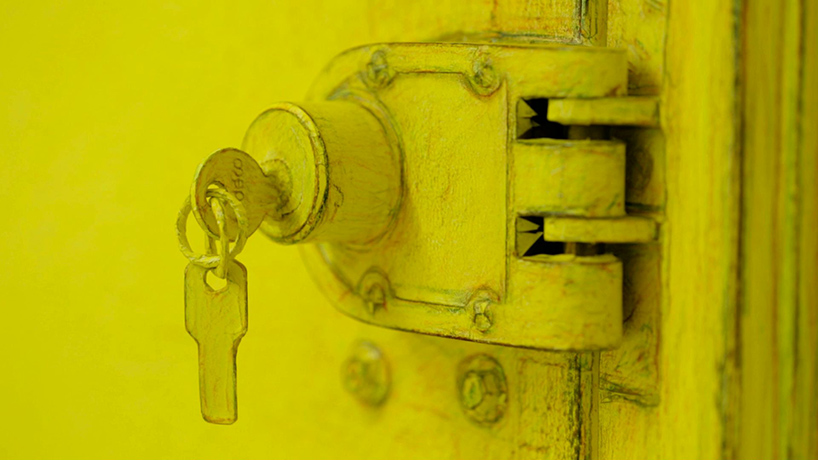
 the process begins by wrapping each and every surface with white paper, covering the walls, ceiling, cabinets and even house keys. suh continues by rubbing colored pencil across the paper sheets

12.11.16

CRAIGSLIST MIRRORS


A selection of the best images of mirrors for sale on Craigslist. Enjoy more HERE

5.11.16

ROLLING SHUTTER PHENOMENON


"Many modern digital cameras use as their ‘sensing’ device a CMOS detector, also known as an active-pixel sensor, which works by accumulating electronic charge as light falls upon it. After a given amount of time, the exposure time, the charge is shifted row-by-row back to the camera for further processing. There is then a finite time where the camera scans down the image, saving rows of pixels at a time. If there is any motion over this timescale the image will be distorted."

Read more HERE 

21.10.16

Candy


A virtual prostitute taken from the game Grand theft auto slowly strolls by viewable through a real car door.


You can send a text message to the virtual prostitute. She can respond with (for an example):
  • Hi sweety I am a bit occupied right now, will call you back later
  • Please buy me


link_virtualrobert

27.9.16

AUTOGYRO


The Bensen X-25 single-seat autogyro. list of experimental aircraft

MEASURES


Instruments of Taylorism - the choreography of labour.

I AM SITTING IN A ROOM

Alvin Lucier


Lucier repeatedly re-records a tape of his own voice as it plays back in a room. With each iteration of the recording, the resonant profile of the room enhances certain frequencies present in the recording - and eventually - the recital of the text is transformed into pure tones, which form the acoustic signature of the room's resonant capabilities. Through this act of curiosity, the room is re-defined as an instrument.

24.9.16

NEGOTIATING THE SEAM


We are an experimental unit – both through an interest in experimental practices in architecture and a belief in the benefits of experimentation as a productive educational method. Two of our key sites of experimentation relate to how ideas are teased out by and embodied in media - the tools and materials through which we design and the materials and processes through which ideas are made real in architecture.

The previous sentence already presumes a commonly held idea of a separation between designing and what is designed. This year we will be looking at a number of seams that lie in between conditions that are often seen to be in opposition in architecture – one of them being reality and representation, with a subset of the relationship between material and pictorial space. We will also look at the realm where utility and desire might not be mutually exclusive and examine how appropriation and the bespoke might be equally capable of precise specificity. We imagine that students in the unit will eek out other seams of their own to inhabit.

Another dimension of experimentation lies in the pleasure of inquisitiveness and the condition of not knowing. While the discovery of knowledge is a benefit of the experimental process, the experience of discovery can be just as rewarding as what is discovered. In her essay Tactics For Not Knowing Emma Coker suggests that:

For the artist, to prepare for the unexpected has a dual function. It is the gesture of developing readiness (for anything), a state of being at the cusp of action, mind and body poised. It is also an act of scarifying the ground, an attempt to create the germinal conditions within which something unanticipated might arise. Artistic practice recognises the value of not knowing, less as the preliminary state (of ignorance) preceding knowledge, but as a field of desirable indeterminacy within which to work. Not knowing is an active space within practice, wherein an artist hopes for an encounter with something new or unfamiliar, unrecognisable or unknown. However, within artistic practice, the possibility of producing something new is not always about the conversion of the not known towards new knowledge, but rather involves the aspiration to retain something of the unknown within what is produced. (Coker, 2013)

One of the reasons why ideas are often located in opposition and simplified is that as a profession we try to appear to have knowledge. In doing so we try to express this knowledge in a form that is not the one we use. Our attempts to make our knowledge explicit through words tend to be a reductive distillation of the meandering subtleties that we hold in our tacit (or personal) knowledge. By developing ideas through the media with which we work this tacit knowledge with all its subtle and intimate pleasures can remain in the thing that we design. The things that are made and drawn in the unit are therefore much more agents of discovery than of presentation or rhetoric, with the possibility of being much more personal to their author - an aspect that we encourage.